
The short version
- Keep the receipt and a short business-purpose note for every non-fuel purchase.
- Separate vehicle operating costs from parking, tolls, gear, and phone expenses.
- Record mixed personal and business use instead of claiming the full amount by default.
Which Dasher expenses should you document besides gas?
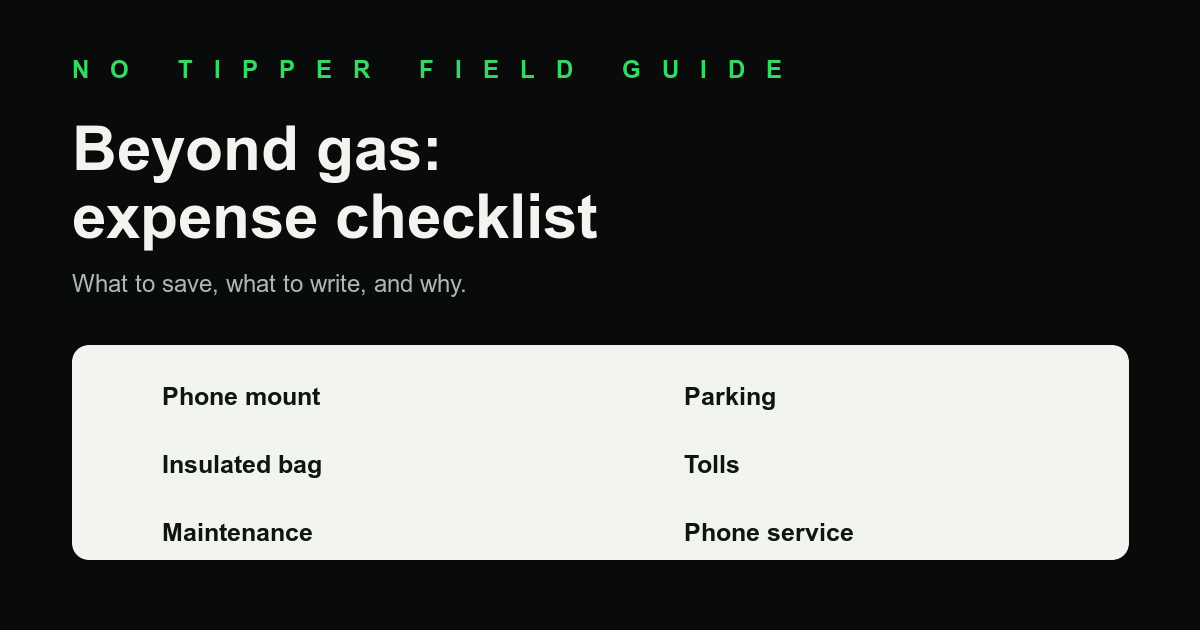
A Dasher should document costs that have a clear delivery-work connection, even when the final tax treatment is uncertain. The practical list includes a phone mount, charging cable, insulated bag, drink carrier, parking fees, tolls, phone service, maintenance, repairs, tires, insurance, registration, and roadside assistance. Keep personal purchases out of the business list.
DoorDash’s own reimbursement FAQ names motor vehicle expenses, servicing, Dasher gear, phone and internet use, tolls, and parking fees as costs it generally does not reimburse. The list is useful as a reminder of what can leave your pocket during a shift. It is not a tax-deduction list.
| Expense | What to record | Why the note matters |
|---|---|---|
| Phone mount or charger | Receipt, date, item, amount, delivery-only or mixed use | Shows what you bought and how work used it |
| Insulated bag or drink carrier | Receipt, vendor, amount, work purpose | Connects the supply to food delivery |
| Maintenance or repair | Invoice, vehicle, odometer, service, amount | Ties the cost to a specific car and date |
| Parking or toll | Receipt or statement, date, location, order or shift | Separates a business stop from personal travel |
| Phone service | Monthly bill and a reasonable business-use calculation | Documents the mixed-use share instead of guessing |
| Insurance or registration | Policy or renewal document, dates, vehicle, amount | Keeps annual vehicle costs available if needed |
Why should vehicle costs stay in their own category?
Vehicle costs need their own category because the standard mileage method and actual-expense method treat them differently. The 2025 Schedule C instructions say a self-employed filer can generally deduct actual car or truck operating expenses or use the standard mileage rate. Under the actual-expense route, the business portion can include gasoline, oil, repairs, insurance, and license plates.
Those same Schedule C instructions say a filer using the standard mileage rate should not also deduct depreciation, lease payments, or actual operating expenses for that vehicle. Parking fees and tolls are added separately in the IRS example. Keep the records first, then decide the method with current instructions or a tax professional instead of mixing both methods in the same calculation.
A maintenance invoice should name the vehicle, service date, odometer, work performed, and total. If one car serves personal errands and delivery work, keep the mileage record that supports the business-use share. The DoorDash mileage tracking guide shows how trip records supply that second half of the picture.
What should you write down for delivery gear and phone use?
For delivery gear and phone use, write down the item, date, price, vendor, business purpose, and any personal-use share. A $27.84 insulated bag used only for deliveries needs a receipt and a note such as “keeps customer orders at temperature during active deliveries.” A phone bill used for both work and personal calls needs a consistent allocation instead of a claim that every dollar was business-related.
Consider an illustrative $72 monthly phone plan. If a driver’s reasonable records support 35 percent business use for that month, the documented business portion is $25.20: $72 multiplied by 0.35. The percentage is an example, not a suggested deduction rate. Your figure should come from your use and current tax guidance.
Small accessories are easy to forget because they disappear into a normal shopping receipt. Circle the work item, save a photo, and add the purpose that day. For drivers moving between platforms, multi-app delivery tracking explains how to keep one shift record while still naming which platform generated each drive.
How do you document parking fees and tolls?
A parking or toll record should include the date, amount, location, and delivery reason. A card statement proves money moved, but the note explains why the charge belongs to a business shift. Add the order, restaurant, or delivery area when that information is available.
Do not group parking tickets with parking fees. The Schedule C instructions say fines and penalties paid to a government for violating a law are not deductible business expenses. A legal meter payment for a pickup and a citation for parking illegally are different records and should never share one category.
A simple entry could read: “2026-10-03, $3.25, Riverfront garage, pickup at Market Hall, DoorDash shift.” A toll entry could name the road and the delivery zone it helped you reach. The Dasher shift checklist gives these notes a natural place in the end-of-shift review.
What is the fastest weekly expense routine?
The fastest weekly expense routine is one 15-minute pass that matches receipts to a short expense list. Start with card transactions, add cash receipts, attach an image, and mark each line as vehicle, gear, phone, parking, toll, or other supply. Flag mixed-use items for later instead of forcing a percentage while you are tired.
Use consistent file names such as 2026-10-03-parking-3-25.jpg and keep the amount in a spreadsheet column that can be totaled. Back up the folder outside the phone. A tidy record still needs the correct tax treatment, but it saves the harder job of rebuilding months of small purchases from bank statements.
Keep fuel estimates separate from paid receipts. No Tipper can estimate fuel from miles, MPG, and gas price, while the DoorDash gas cost guide explains the formula and its limits. An estimate helps compare trips; a receipt documents what you paid.
Trip details, fuel estimates, messages, and exports in one place.
No Tipper is an iOS app for delivery drivers that records trip time and mileage, estimates gas cost from vehicle inputs, prepares rule-based customer messages, and exports trip records as CSV or PDF through No Tipper Pro.
Free to download. No Tipper Pro unlocks unlimited saved trips, CSV/PDF export, and custom message templates for $1.99/month or $19.99/year in the US. Plans auto-renew; cancel in Apple Subscriptions. Confirm any trial eligibility in the app.
Common questions
Can a Dasher track both mileage and maintenance?
Yes, and keeping both records preserves your options. The deduction method determines how vehicle operating costs are treated, so do not add actual vehicle costs on top of the standard mileage rate without checking the rules.
Should I keep receipts for small delivery supplies?
Yes. Save the receipt and note the business purpose, especially when the item appears on a receipt with personal purchases.
Are parking tickets a business expense?
No. IRS Schedule C instructions say government fines and penalties for violating a law are not deductible business expenses.
How should I track a phone used for work and personal use?
Keep the monthly bill and a reasonable, consistent record of the business-use share. Do not assume the whole bill is a business cost.
Does saving a receipt make an expense deductible?
No. A receipt documents the purchase. Eligibility depends on the business connection, the tax rules, and your facts.
No Tipper is an independent utility and is not affiliated with or endorsed by DoorDash. Platform features and policies can change; check official platform guidance when a question depends on current DoorDash rules.