
The short version
- Multiply the price difference by the gallons you expect to buy before you chase a cheaper sign.
- Charge the extra round-trip miles and queue fuel against that pump-price saving.
- Set a personal value for off-route minutes so the comparison reflects your shift.
How should I compare cheap gas prices near me?
Compare cheap gas prices near you using the same fuel grade and payment method, then multiply the price difference by the gallons you plan to buy. Subtract the fuel used for the round-trip detour and count the queue when it takes time away from a delivery shift.
No Tipper is an iOS delivery-driver tool that turns a pump price you confirm, trip miles, and vehicle MPG into an estimated fuel cost. It does not retrieve live station listings, so confirm the sign before committing to the turn.
Local variation matters more than a national headline. The U.S. Energy Information Administration reported an average of $4.496 per gallon for all grades and formulations for the week of October 5, 2026. That figure dates the example. Your next pickup and the prices on nearby signs decide the local comparison.
Keep the gas calculation beside the shift record. The shift fuel cost calculator explains how miles, MPG, and price per gallon turn into a fuel estimate, while this comparison adds the cost of going out of your way to fill up.
How do I check gasoline station prices near me?
Check a current local price source, then confirm the station, fuel grade, cash or credit terms, and pump price before driving out of your way. Put that confirmed price into the detour test with your gallons, vehicle MPG, and extra round-trip miles.
Is a Shell gas station near me worth the detour?
A nearby Shell station is worth the detour only when its confirmed pump saving covers the extra fuel and time required to reach it. Apply the same test to Shell or any other brand: compare equal grades and payment terms, then use your own gallons, MPG, round-trip miles, and expected wait.
What formula finds the real cost of cheap gas?
The real cost of cheap gas adds the pump total, detour fuel, queue fuel, and whatever value you assign to the extra minutes. Keep the fill amount and time value identical for every station so you can compare them cleanly.
For a gasoline car, calculate pump total as gallons bought multiplied by price per gallon. Calculate detour fuel as extra miles divided by your vehicle MPG, then multiplied by that station’s price. Queue fuel is idle hours multiplied by idle gallons per hour and price per gallon. If you turn the engine off while parked, enter zero for idle fuel.
When does the lowest posted price lose?
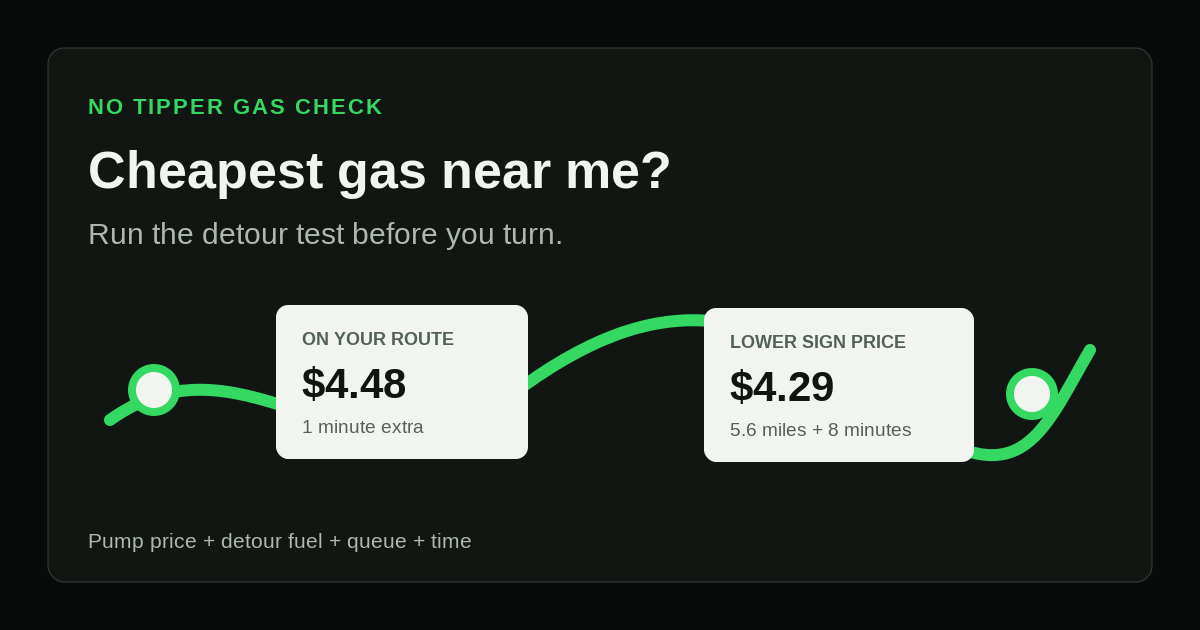
The lowest posted price loses when extra driving and waiting consume a small per-gallon saving. Here’s one illustrative shift: the driver needs 11.2 gallons, gets 27 MPG, and values off-route time at $18 per hour. Station A is nearly on the route at $4.48 per gallon. Station B charges $4.29 and adds 5.6 round-trip miles plus an estimated 8-minute queue.
The Department of Energy says vehicles typically burn 0.25 to 1 gallon per hour while idling. This example uses the low end, 0.25 gallon per hour, and assumes the engine stays on in line. Your car, accessory use, weather, and station layout can change that number.
| Cost item | Station A, on route | Station B, lower sign price |
|---|---|---|
| Posted price | $4.48 per gallon | $4.29 per gallon |
| 11.2-gallon pump total | $50.18 | $48.05 |
| Extra detour fuel | $0.07 for 0.4 mile | $0.89 for 5.6 miles |
| Queue fuel | $0.00 | $0.14 for 8 minutes |
| Time value | $0.30 for 1 minute | $2.40 for 8 minutes |
| Real fill cost | $50.55 | $51.48 |
Station B saves $2.13 at the pump, but the longer detour and queue bring its real fill cost to $51.48. Station A finishes at $50.55, so the higher sign price is 93 cents cheaper for this stop. The result changes with the fill size. A nearly empty tank gives the per-gallon discount more room to matter, while a five-gallon top-up makes a detour harder to justify.
How should idle time count during a delivery shift?
Idle time should count as fuel when the engine runs and as lost shift time whenever the stop takes longer. Give those two costs separate lines. That avoids pretending every waiting minute burns the same amount of gas or would have produced a paid order.
Choose a time value for planning only; it doesn’t promise earnings. Pick a round number that reflects what an off-route minute is worth to you, such as $15 or $18 per hour, then use it consistently. If the station is your planned break and you would stop working anyway, the time value may be zero. If the queue pulls you away during your busiest dinner window, the minutes may decide the comparison.
The Department of Energy’s guidance puts the fuel side plainly: “When idling, vehicles typically burn from 0.25 to 1 gallon of fuel per hour.” Shut the engine off when it is safe and legal to do so, then remove idle fuel from the math while keeping the actual wait time.
What is the fastest station decision before a shift?
The fastest station decision is a three-number check: gallons needed, cents saved per gallon, and extra minutes. Multiply gallons by the price difference. If that gross saving is already smaller than your time value, use the closer station. If the saving survives, subtract detour and idle fuel next.
Record the fill before the first order or during the end-of-shift review. The Dasher shift checklist gives fuel settings and trip review a fixed place, which keeps a station stop from disappearing into the rest of the evening. If the detour was part of your business driving, keep its purpose with the trip rather than trying to rebuild it later.
No Tipper does not publish live station prices. Enter the pump price you actually pay, then use your own MPG and trip miles. The DoorDash mileage log covers how to keep the drive and its distance tied to the same shift record.
Trip details, fuel estimates, messages, and exports in one place.
No Tipper is an iOS app for delivery drivers that records trip time and mileage, estimates gas cost from vehicle inputs, prepares rule-based customer messages, and exports trip records as CSV or PDF through No Tipper Pro.
Free to download. No Tipper Pro unlocks unlimited saved trips, CSV/PDF export, and custom message templates for $1.99/month or $19.99/year in the US. Plans auto-renew; cancel in Apple Subscriptions. Confirm any trial eligibility in the app.
Common questions
How do I find the cheapest gas prices near me?
Check current local listings, confirm the posted price at the station, and compare the pump saving with round-trip detour miles and expected wait time.
How far should I drive for cheaper gas?
Drive only as far as the expected pump saving covers the extra fuel and time. A large fill can support a longer detour than a small top-up.
Does waiting in a gas line use much fuel?
It can. The Department of Energy says idling vehicles typically burn 0.25 to 1 gallon per hour, depending on the vehicle and conditions.
Should a delivery driver value time in the gas comparison?
Yes, if the stop takes time away from the shift. Use your own planning value per hour and set it to zero when the fuel stop doubles as a break you already planned.
No Tipper is an independent utility and is not affiliated with or endorsed by DoorDash. Platform features and policies can change; check official platform guidance when a question depends on current DoorDash rules.