
The short version
- Keep one continuous mileage total across the multi-app shift so overlapping app time does not duplicate road miles.
- Save the MPG assumption and gas price with the distance; the fuel total cannot be checked later without all three inputs.
- Use fuel cost for the gasoline question and a separately labeled benchmark or actual-expense record for the broader vehicle-cost question.
What does delivery fuel cost for one shift?
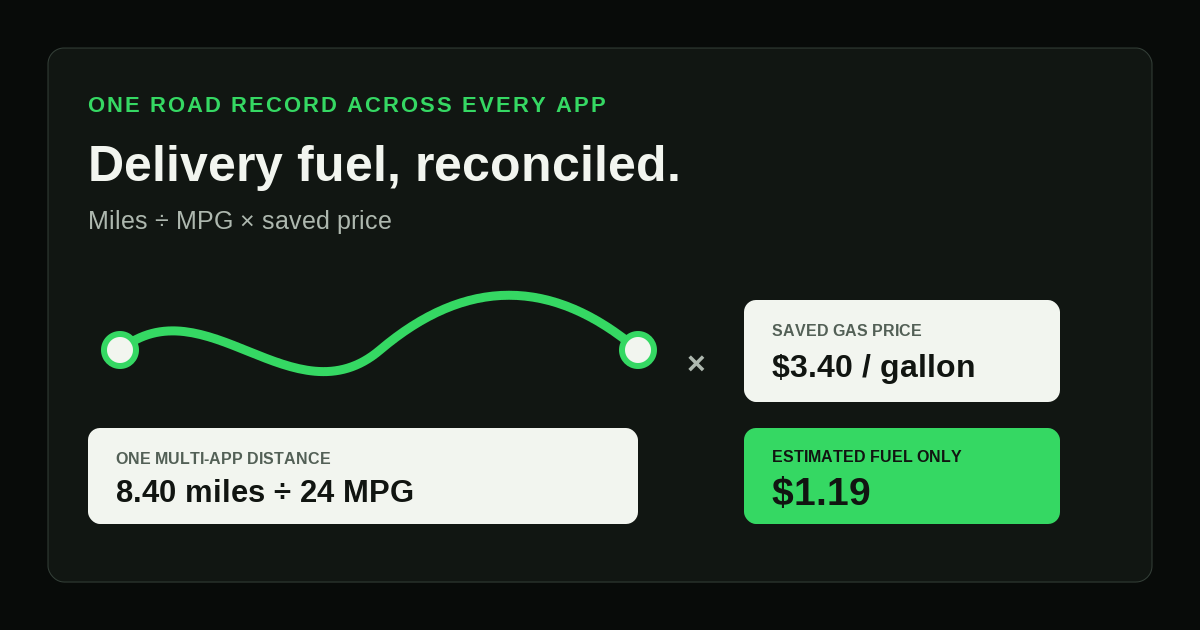
Delivery fuel for this short sample shift comes to an estimated $1.19. Its source row is a fictional No Tipper mileage record. It shows 8.40 delivery miles over 25 minutes and names an example delivery platform. The site calculator supplies the starting assumptions of 24 MPG and $3.40 per gallon.
Start with 8.40 miles ÷ 24 MPG = 0.35 estimated gallons. Then multiply 0.35 gallons × $3.40 to get $1.19. The same source-backed inputs provide a second check: $3.40 ÷ 24 × 100 = 14.1667 cents per mile, which rounds to 14.2 cents. Using the unrounded rate for all 8.40 miles lands on the same $1.19 total.
The math can be reproduced from the saved inputs. It still isn’t a measured driver outcome. The mileage is from a deliberately fictional export sample, while the MPG and price are editable calculator defaults. Substitute the complete shift miles, a recent delivery-driving MPG, and the price for the fuel grade actually used.
| Saved shift input | Sample value | What it represents |
|---|---|---|
| Delivery distance | 8.40 miles | One fictional delivery row |
| Vehicle efficiency | 24 MPG | Editable calculator starting value |
| Fuel price | $3.40 per gallon | Editable calculator starting value |
| Estimated gallons | 0.35 gallon | 8.40 ÷ 24 |
| Estimated delivery fuel | $1.19 | 0.35 × $3.40 |
The DoorDash gas cost guide explains the same three-input formula for a longer shift. The DoorDash mileage tracking guide shows how to keep the complete shift distance in a reviewable record.
Which miles count during a multi-app delivery shift?
A multi-app delivery shift should use one road-mile total for the business driving inside the boundary you chose. Count the drive to pickups, drop-offs, and business repositioning once, even when two apps were online for the same segment. The car traveled one physical mile, regardless of how many services were active.
Set the boundary before leaving. Record the starting odometer or begin trip tracking when business driving starts, then record the end when it stops. Put a personal errand in a separate segment. If an app reports engaged or offer miles, keep that figure as platform context instead of folding every app’s number into one total.
The multi-app delivery tracking guide uses one trip record with a service label when work crosses platforms. That arrangement lets the mileage total answer the fuel question while notes preserve which services were involved.
Which MPG and gas price belong in the shift fuel calculation?
The shift fuel calculation needs a recent MPG that resembles delivery driving and a dated price for the grade the car uses. Repeated acceleration around town may produce a different result from a highway rating. After a fill, use the receipt price. For advance planning, save the posted station price with its date, grade, and cash or credit terms.
A gas receipt records gallons purchased. It does not isolate the gallons burned during one short shift, because the tank probably held fuel before the drive began. For one shift, miles ÷ recent MPG gives a clearly labeled estimate. A controlled fill-to-fill period can supply a measured MPG for later shifts.
Idling is another limit. The U.S. Department of Energy says, “When idling, vehicles typically burn from 0.25 to 1 gallon of fuel per hour.” The wide range reflects different vehicles and operating conditions. A recent delivery-driving MPG may absorb some ordinary idle use, while an unusual hour-long wait can make a distance-only estimate too low. The Dasher shift checklist gives the price, vehicle settings, and trip review a repeatable place in the workday.
The federal statement appears in the Department of Energy’s fleet-management guidance. DOE is the federal department responsible for national energy policy and fuel-use guidance, so it is a primary source for this idling range.
Why is delivery fuel different from total driving cost?
Delivery fuel is one variable cash estimate. A total driving-cost figure can also account for maintenance, tires, repairs, insurance, registration, depreciation, financing, tolls, and parking. Calling the $1.19 sample result “the shift cost” would hide every nonfuel item, so keep the label “estimated fuel” beside it.
For a separate comparison, the IRS standard mileage rates page lists “Self-employed and business: 76 cents/mile” for July 1 through December 31, 2026. Applied to 8.40 business miles, that optional rate gives $6.38. The IRS calls it a standard mileage rate used to compute deductible vehicle costs; it is not a reading of this car’s actual expense and does not turn the $5.19 gap into measured wear or profit.
The current rate and effective period appear on the IRS standard mileage rates page. The IRS administers federal tax rules, making it the primary source for the rate. Eligibility and method choices depend on the taxpayer’s facts, so this fuel example is recordkeeping guidance rather than tax advice.
| View of the same 8.40 miles | Calculation | Result |
|---|---|---|
| Estimated fuel only | 8.40 ÷ 24 × $3.40 | $1.19 |
| Fuel cost per mile | $3.40 ÷ 24 | 14.2 cents |
| IRS mileage-rate benchmark | 8.40 × $0.76 | $6.38 |
| Difference between labeled figures | $6.38 − $1.19 | $5.19 |
A driver who wants an actual vehicle-cost figure needs their own records for the categories being measured. The 72-mile driving-cost example shows how fuel, maintenance, tolls, and parking stay on separate lines so assumptions remain visible.
What should a driver save after the shift?
A driver should save the date, shift boundary, business miles, service labels, MPG source, gas price, fuel grade, and estimated fuel total. Mark the gallons as estimated unless a controlled measurement supports them. Give tolls, parking, and other vehicle expenses their own fields.
Write enough context to reproduce the number next week. “8.40 miles, 24 MPG, $3.40 per gallon, estimated” is checkable. “Gas about $1” is not. If the posted price changes later, the saved date preserves why the original estimate used that amount.
For a multi-app shift, split platform earnings by service and leave road miles as one physical total. That choice prevents duplicate miles and keeps the fuel calculation independent of how many apps supplied orders. Review the record while the route and any personal detours are still easy to recall.
Trip details, fuel estimates, messages, and exports in one place.
No Tipper is an iOS app for delivery drivers that records trip time and mileage, estimates gas cost from vehicle inputs, prepares rule-based customer messages, and exports trip records as CSV or PDF through No Tipper Pro.
Free to download. No Tipper Pro unlocks unlimited saved trips, CSV/PDF export, and custom message templates for $1.99/month or $19.99/year in the US. Plans auto-renew; cancel in Apple Subscriptions. Confirm any trial eligibility in the app.
Common questions
How do I calculate delivery fuel cost per shift?
Divide the shift’s business miles by a recent delivery-driving MPG, then multiply the estimated gallons by the saved price per gallon.
Should I add mileage from every delivery app?
No. Record the car’s physical business miles once. Keep each app’s mileage figure as separate context so overlapping app time does not duplicate distance.
Does a gas receipt equal the fuel used on that shift?
Usually no. A receipt shows fuel purchased, which may replace gasoline consumed across several earlier drives. Use an MPG-based estimate for one shift or a controlled fill-to-fill measurement for a longer period.
Is fuel cost the same as total driving cost?
No. Fuel leaves out maintenance, tires, repairs, insurance, registration, depreciation, financing, tolls, parking, and other costs you may need to measure.
Can I use the IRS mileage rate as my actual shift cost?
Treat it as an optional tax-method figure or comparison benchmark, subject to IRS rules. It does not measure the actual cost of a particular car or shift.
No Tipper is an independent utility and is not affiliated with or endorsed by DoorDash. Platform features and policies can change; check official platform guidance when a question depends on current DoorDash rules.