
The short version
- Fuel is the near-term cash estimate: miles ÷ MPG × gas price.
- A mileage deduction is a tax method and broader cost benchmark, not cash paid back to the driver.
- Time belongs in a job decision even though it does not appear on a fuel receipt or mileage log.
What numbers make up the price of a trip?
The price of a trip can be read through three separate numbers: fuel cash, a mileage-based vehicle amount, and time value. Fuel answers what the gasoline is expected to cost. A mileage amount stands in for the cost or deduction method you choose. Time answers what those hours need to be worth before the trip makes sense to you.
Do not add a standard mileage amount and actual gas as though they are two independent tax deductions for the same miles. The Internal Revenue Service says use of the standard mileage rate is optional and taxpayers may instead calculate actual vehicle costs. For trips after July 1, 2026, the IRS lists the self-employed and business rate as 76 cents per mile.
Keep the underlying miles reliable before applying either method. The DoorDash mileage tracking guide explains how to review the trip distance and category so one route does not acquire three different mileage totals.
What is the price of a 54-mile delivery trip?
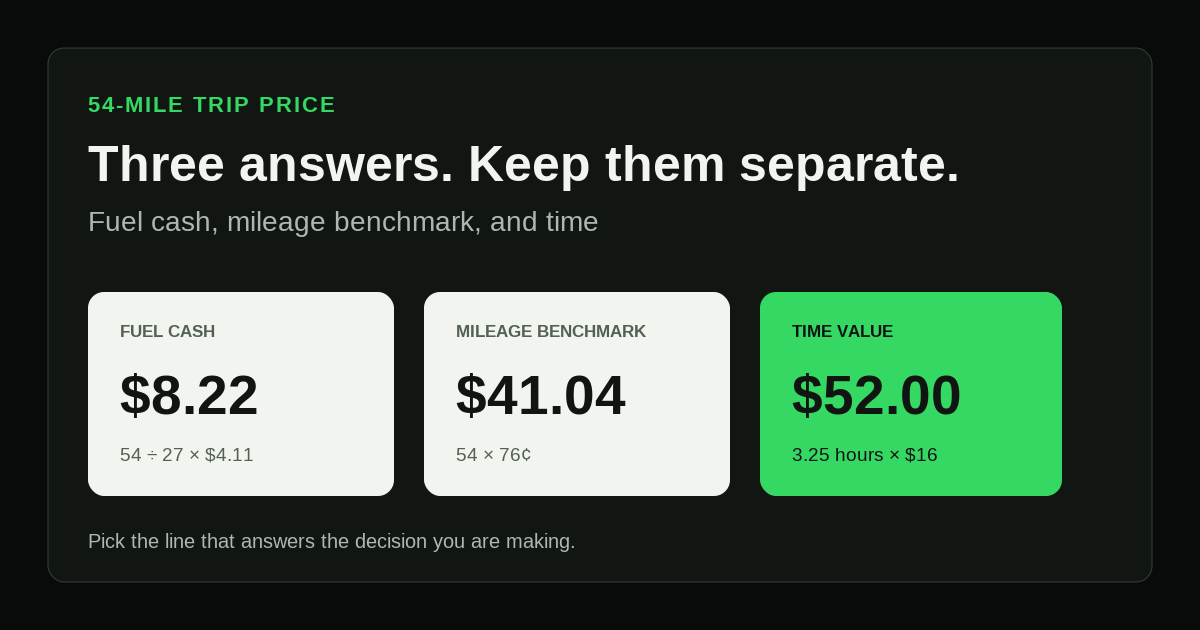
A 54-mile delivery block in a 27-MPG car uses an estimated 2 gallons. At $4.11 per gallon, fuel is $8.22. The block lasts 3 hours 15 minutes, or 3.25 hours, and the driver uses a personal planning value of $16 per hour, making the time line $52.00.
The current IRS business mileage rate gives a separate 54 × $0.76 = $41.04 benchmark. The IRS says the business rate is based on a study of fixed and variable automobile costs. That is why the $41.04 already reaches beyond gasoline and should not be stacked with the $8.22 when using the rate as a broad vehicle-cost proxy.
| Trip lens | Calculation | Amount |
|---|---|---|
| Fuel cash estimate | 54 miles ÷ 27 MPG × $4.11 | $8.22 |
| Mileage benchmark | 54 business miles × $0.76 | $41.04 |
| Time value | 3.25 hours × $16 | $52.00 |
| Planning floor | $41.04 vehicle benchmark + $52.00 time | $93.04 |
The $93.04 planning floor is a decision tool built from the driver’s chosen time value and the IRS rate as a vehicle-cost proxy. It is not a promised earning, a tax refund, or an invoice. If you are checking only tonight’s fuel cash, the answer is $8.22. If you are deciding what this block needs to cover before it feels worthwhile, the broader lines matter.
How does fuel change the price of a trip?
Fuel changes the price of a trip through distance, MPG, and price per gallon. More miles raise gallons used. Better MPG lowers them. A higher pump price increases the dollar result without changing the route itself.
In this example, each 10-cent change in gas price moves the 54-mile fuel estimate by 20 cents because the trip uses 2 gallons. That sensitivity is handy when prices move during the week: update the price line and leave the recorded miles alone.
The DoorDash gas cost guide covers this fuel-only formula in more detail. Use it when the question is how much gasoline the shift consumed, then return to the other lines only if the decision calls for them.
How should the mileage deduction affect trip price?
The mileage deduction should be treated as a tax calculation method, not as money deposited for every mile. For an eligible self-employed driver, the rate can help calculate deductible vehicle cost when the standard-mileage method applies. Eligibility and method choices depend on the taxpayer and vehicle, so a tax professional should answer filing questions.
For planning, 76 cents per mile can serve as a dated outside benchmark because the IRS says the business rate reflects fixed and variable automobile costs. It is not a measurement of your car. A paid-off compact with low insurance and a newer financed SUV can have very different actual costs while producing the same standard-rate multiplication.
If you use actual expenses for your planning sheet, build that vehicle line from your own fuel, maintenance, insurance, registration, financing, and depreciation choices. Keep tolls and parking visible when they apply instead of assuming a generic per-mile figure captured each trip-specific charge.
How do you put time into the price of a trip?
Put time into the price of a trip by choosing an hourly planning value and multiplying it by the full block of time the work occupied. Include waiting and repositioning when those minutes belong to the block. A 3.25-hour trip at $16 per hour carries a $52 time value.
The hourly figure is personal planning math, not a statement about guaranteed earnings. One driver may use a minimum cash target. Another may compare the block with a different kind of work or with going home. Use the same figure across several similar trips before changing it, or every result will reflect a new rule.
Record start and stop times while they are fresh. The Dasher shift checklist places that review at the end of the shift, alongside mileage and fuel inputs, so time does not become a guess made days later.
Which trip-price number should you use?
Use the number that matches the decision. Use $8.22 when asking how much fuel this 54-mile trip is estimated to burn. Use the mileage method selected for your records when discussing deductible vehicle cost. Use $93.04 only as this driver’s planning floor for vehicle cost plus time.
Label the result beside the number. “Fuel estimate,” “mileage benchmark,” and “planning floor” are harder to confuse than three totals all called trip cost. The label also keeps a future reader from subtracting an estimated tax deduction directly from cash expenses.
A delivery offer may still have details that this framework does not price well, such as an unusually difficult pickup, a paid parking risk, or a return drive outside the zone. Add those as named lines. Do not bury them by changing MPG or the hourly value until the table produces the answer you hoped to see.
Trip details, fuel estimates, messages, and exports in one place.
No Tipper is an iOS app for delivery drivers that records trip time and mileage, estimates gas cost from vehicle inputs, prepares rule-based customer messages, and exports trip records as CSV or PDF through No Tipper Pro.
Free to download. No Tipper Pro unlocks unlimited saved trips, CSV/PDF export, and custom message templates for $1.99/month or $19.99/year in the US. Plans auto-renew; cancel in Apple Subscriptions. Confirm any trial eligibility in the app.
Common questions
What is the simplest way to estimate the price of a trip?
Start with fuel: divide miles by MPG and multiply by gas price. Add a separate vehicle-cost method and time value only when the decision needs a broader price.
Is the IRS mileage rate the same as my fuel cost?
No. The IRS says the business rate is based on fixed and variable automobile costs. Fuel is only one part of that broader rate.
Can I add gas to the standard mileage deduction?
Do not count gas again as though it were separate from the standard mileage method for the same miles. Ask a tax professional which deduction method applies to your situation.
Why include time in a trip-cost estimate?
Time helps with a work decision even though it is not a vehicle expense. Giving the full trip block an hourly planning value shows what the job needs to cover for that driver.
No Tipper is an independent utility and is not affiliated with or endorsed by DoorDash. Platform features and policies can change; check official platform guidance when a question depends on current DoorDash rules.