
The short version
- Use the complete delivery distance, including business miles between orders when they belong in your shift record.
- Use your recent real-world MPG when you have it, since a delivery shift may not match a highway rating.
- Treat the result as fuel only; maintenance, insurance, depreciation, tolls, parking, and time are separate.
What does a trip mileage estimator calculate?
No Tipper is an iOS delivery-driver tool that keeps trip mileage and an estimated fuel cost together. Enter the complete trip distance, your vehicle’s MPG, and the pump price to estimate fuel for one delivery shift.
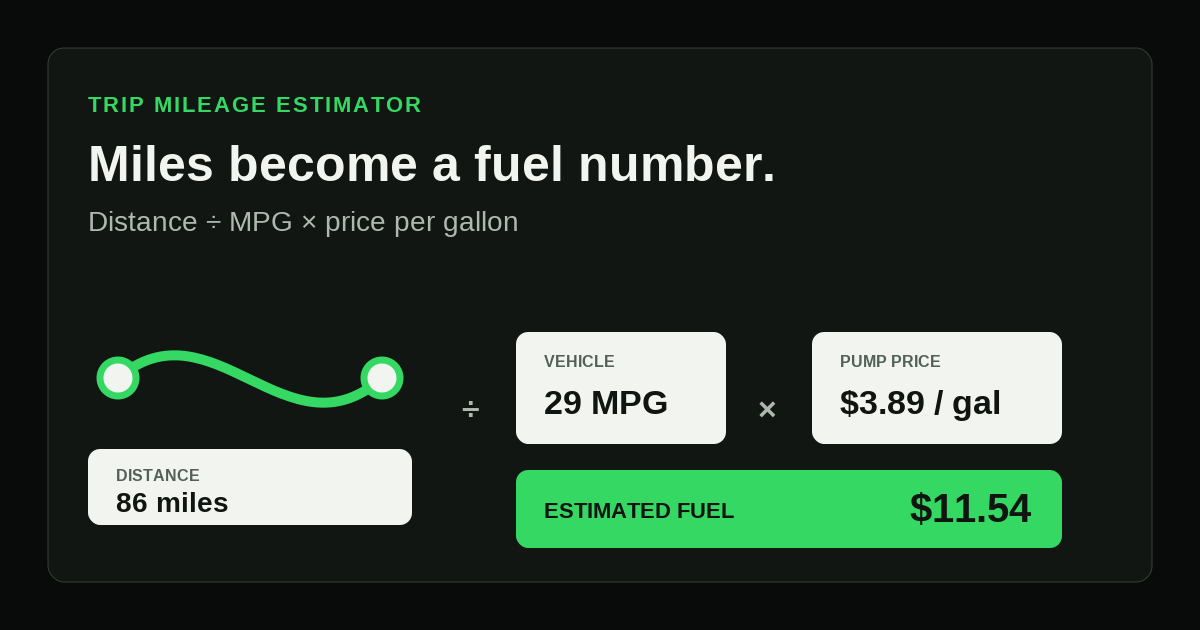
A trip mileage estimator calculates gallons used, fuel cost, and fuel cost per mile from three inputs: distance, MPG, and price per gallon. Distance tells the estimator how much driving happened. MPG describes how far the vehicle travels on one gallon. The pump price puts a dollar value on that fuel.
The U.S. Department of Energy describes its FuelEconomy.gov Trip Calculator in much the same way: a driver can personalize fuel price and the share of city versus highway driving when comparing route fuel costs. That city-and-highway split matters for delivery work because repeated stops can make the window-sticker highway MPG a poor input.
A mileage estimate becomes more useful when the distance comes from a consistent trip record. The DoorDash mileage tracking guide explains how to keep the start, stop, duration, and miles together instead of trying to reconstruct the route later.
How do you estimate fuel for an 86-mile delivery shift?
An 86-mile delivery shift uses an estimated 2.966 gallons in a car averaging 29 MPG. At $3.89 per gallon, those gallons cost $11.54 when the calculation keeps the full fraction until the final cent: 86 ÷ 29 × $3.89 = $11.54.
Keep full precision in the calculator and round only the final dollar result. If you round 2.966 gallons to 3.0 too early, the total becomes $11.67. Thirteen cents will not decide one shift, but repeated early rounding can make a month of estimates look less consistent.
| Estimator line | Arithmetic | Result |
|---|---|---|
| Distance | 54 delivery miles + 32 return and repositioning miles | 86 miles |
| Estimated fuel | 86 miles ÷ 29 MPG | 2.966 gallons |
| Estimated fuel cost | 2.966 gallons × $3.89 | $11.54 |
| Fuel cost per mile | $11.54 ÷ 86 miles | 13.4 cents |
This example is deliberately a fuel estimate, not a claim about the whole cost of using the car. The DoorDash gas cost guide uses the same three inputs and explains why actual pump use can differ from the estimate.
Which miles belong in the trip distance?
The trip distance should cover the drive you are trying to price. For a single order, use the business route you want to measure. For a full shift, use the shift’s business miles rather than one app’s pickup-to-drop-off display. Keep personal errands out of the business total so the fuel estimate and mileage record answer the same question.
Start and end points cause most distance mistakes. A map route may show the drive from restaurant to customer while leaving out the approach to the restaurant, repositioning between orders, or the return from the last delivery. Decide the boundary before entering a number, then label the estimate “order,” “segment,” or “shift.”
If you are choosing between two stations, include the station detour as its own route segment. The cheapest-gas detour test compares the pump discount with the extra miles and queue rather than hiding the detour inside the main shift.
Which MPG should a delivery driver enter?
A delivery driver should enter a recent MPG that resembles the route being estimated. Use a city or mixed-driving figure for a stop-heavy shift and a highway figure only when the trip is mostly steady-speed driving. If the dashboard shows a reliable recent average, record the period it covers so you can compare like with like.
The Department of Energy’s vehicle-cost tools separate city and highway fuel economy because vehicle efficiency changes with how the car is used. A single blended MPG is still practical for a quick estimate. Just avoid selecting the best number available when the shift itself is mostly traffic, short blocks, and repeated acceleration.
When you do not know the real-world MPG yet, begin with the manufacturer or FuelEconomy.gov figure closest to the route mix and mark it as an assumption. After the next fill, divide miles driven by gallons added for a measured check. Do not change the estimate retroactively unless you are correcting a known input error.
Which gas price gives the best trip estimate?
The best gas price is the price for the grade you actually buy at the station you reasonably expect to use. A local posted price is more relevant than a national average, and a receipt is better than a remembered sign. Update the input after a fill when the price has moved enough to matter to you.
For the 86-mile example, a 30-cent price change moves the estimate by about 89 cents because the shift uses roughly 2.966 gallons. The mileage stays the same. This is why a saved trip can be recalculated with a new pump price without changing its recorded distance.
What does a trip mileage estimator leave out?
A basic trip mileage estimator leaves out every cost that is not represented by distance, MPG, and gas price. It does not price tires, oil, repairs, insurance, depreciation, tolls, parking, financing, or the driver’s time. It also cannot see extra idling unless that fuel use is already reflected in the MPG input.
Use the fuel result for a fuel question. If you need a broader job decision, put the other costs on separate lines so nobody mistakes an $11.54 gas estimate for the full price of an 86-mile shift. The price-of-a-trip guide keeps fuel, a mileage benchmark, and time on separate lines. That separation also makes the number easier to update: a new pump price changes fuel, while a parking charge changes only the parking line.
Trip details, fuel estimates, messages, and exports in one place.
No Tipper is an iOS app for delivery drivers that records trip time and mileage, estimates gas cost from vehicle inputs, prepares rule-based customer messages, and exports trip records as CSV or PDF through No Tipper Pro.
Free to download. No Tipper Pro unlocks unlimited saved trips, CSV/PDF export, and custom message templates for $1.99/month or $19.99/year in the US. Plans auto-renew; cancel in Apple Subscriptions. Confirm any trial eligibility in the app.
Common questions
What formula does a trip mileage estimator use?
Divide trip miles by MPG to estimate gallons, then multiply estimated gallons by the price per gallon. Divide the fuel total by miles if you also want fuel cost per mile.
Can I estimate mileage cost without knowing my exact MPG?
Yes. Start with the city, highway, or combined MPG closest to the route and label it as an assumption, then replace it with a recent measured average when available.
Does a trip mileage estimate include maintenance?
No. The basic distance, MPG, and gas-price formula estimates fuel only. Maintenance, insurance, depreciation, tolls, parking, and time need separate lines.
Should I round gallons before calculating trip cost?
Keep the full gallons result through the multiplication and round the final fuel cost to the nearest cent. Early rounding can shift the answer.
No Tipper is an independent utility and is not affiliated with or endorsed by DoorDash. Platform features and policies can change; check official platform guidance when a question depends on current DoorDash rules.